
St. Petersburg
Why Some Streets Just Feel Better
Brick streets, live oaks, old houses, flowering trees and the small details that give St. Petersburg its sense of place.
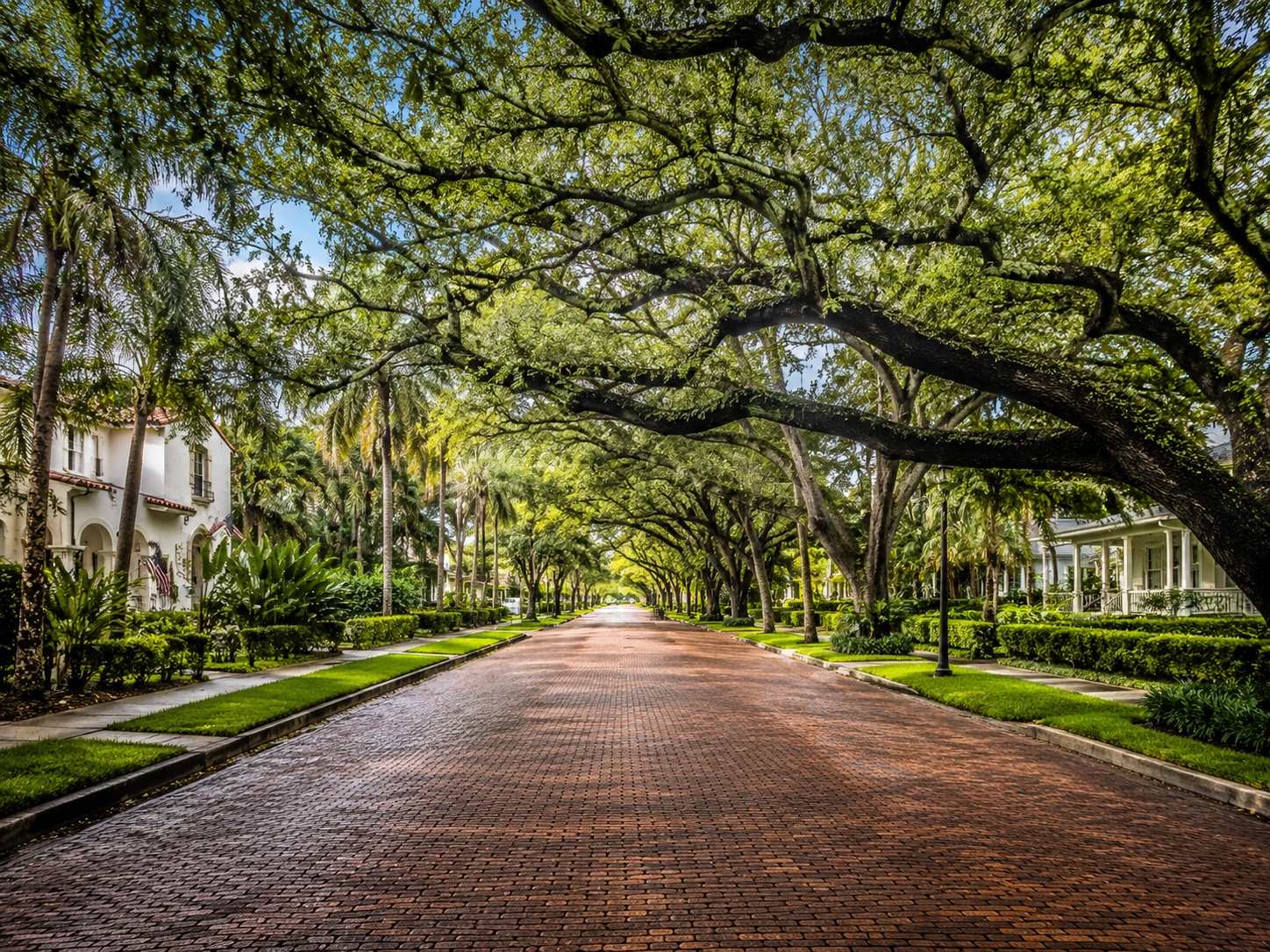
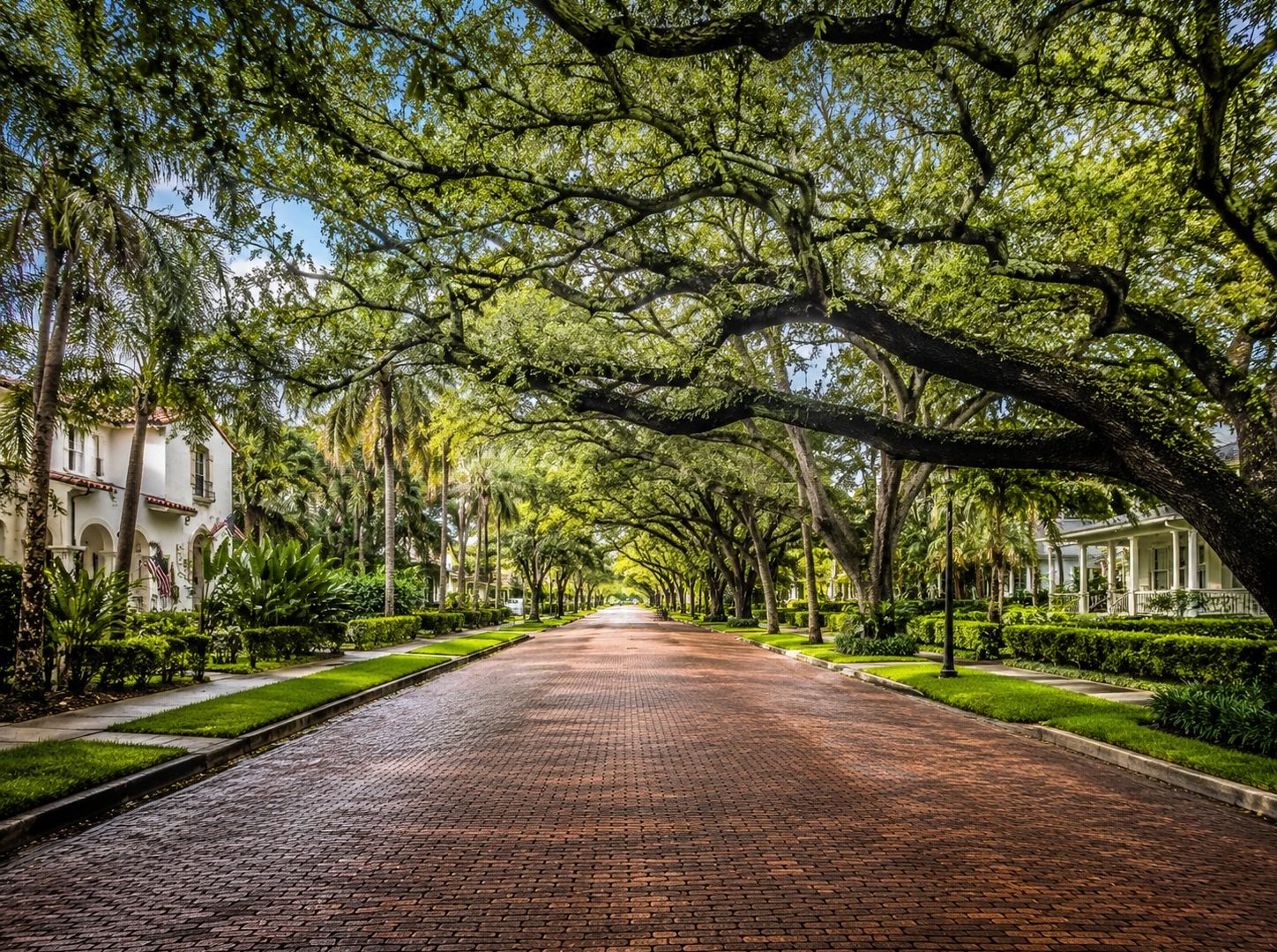
There are streets in St. Petersburg that rearrange your mood before you have time to invent a reason. You turn a corner and the light changes. Brick answers under the tires. A live oak throws a cooler shadow across the windshield. Sunlight moves through the canopy in broken coins of gold. Somewhere a porch sits a little deeper under flowering vines, and the houses stop feeling like inventory and start feeling like a conversation that has been going on for decades.
Most people cannot name what happened in that first half-second. They only know the street feels better. Perhaps it is the canopy. Perhaps it is the setbacks, the gardens, the age of the houses, the way a tended yard sits beside another with equal care. More often it is all of those things at once — hundreds of small decisions accumulated over time.
That is what this essay is about: not a ranked tour of St. Petersburg neighborhoods, but the details that give a street its character, and the way those details teach you how to look at a city.
The street is more than the houses
We talk about neighborhoods as if houses were the whole story. In practice, the street is doing much of the emotional work. Tree canopy softens the sky. Brick paving slows the eye as much as the car. Front gardens and porches create a rhythm from lot to lot. Maintenance — or the absence of it — becomes part of the architecture.
I notice this constantly while walking or driving. Sunshine affects my mood more than I pretend it does. Mature trees do, too. So does the difference between a yard that has been tended and one that has been allowed to become overgrown. A cared-for landscape does not have to be formal or expensive. It simply has to look as if someone is paying attention. When that attention disappears, the houses may still be fine, yet the block feels thinner anyway.
In St. Petersburg, that street-level composition can change within a few blocks. One stretch feels tropical and open. Another is quieter under live oaks. A third leans cottage-garden and clipped hedge. Florida is often caricatured as a single landscape of lawn and palm. Here, the landscaping refuses to stay in character for long.
There is also an emotional difference between looking at homes as inventory and feeling the personality of a street. Inventory asks square footage and garage count. Personality asks whether you would want to come home to this canopy every evening. Those quieter questions often decide whether a house becomes a life or merely a transaction.
The feeling of a neighborhood is created by hundreds of small decisions accumulated over decades.
The trees that make the street
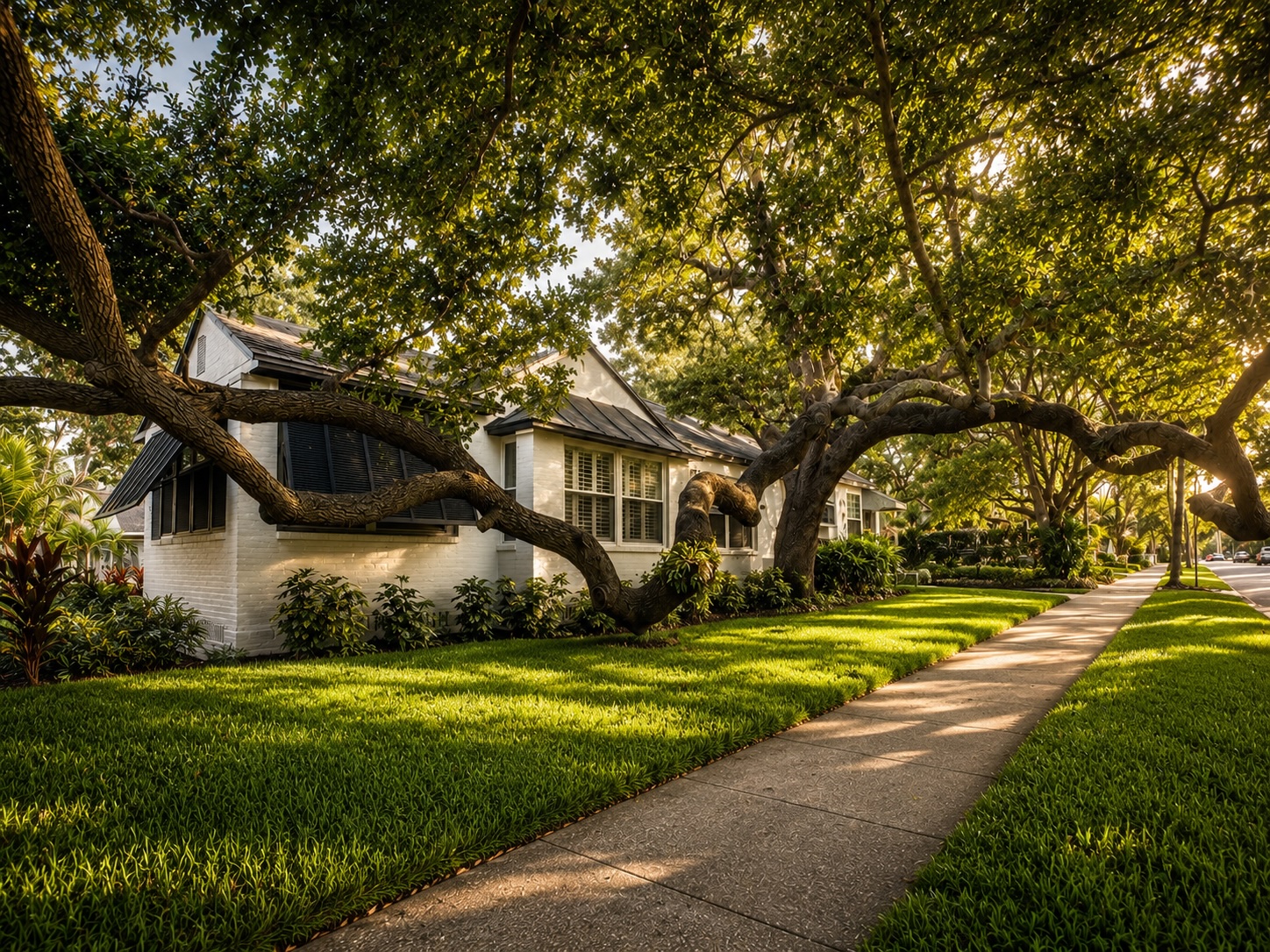
If houses are the nouns of a street, trees are often the grammar. A mature live oak does not merely decorate a lot. It sets the scale of the sidewalk, cools the asphalt, frames the façades, and tells you that someone, somewhere along the way, chose not to erase what time had already made beautiful.
That change in scale is difficult to overstate. Under a full canopy, even an ordinary house can feel settled and generous. Without it, the same house can feel exposed, hotter, more temporary.
That is why the unnecessary removal of healthy, safe mature trees can feel like a kind of civic amnesia. There are times when a tree must come down for legitimate reasons. Even so, the loss is rarely private. The canopy belonged to the street as much as to the property line. When a large live oak or flowering tree disappears without necessity, the block often looks permanently younger in the wrong way: brighter, flatter, less remembered.
Preserving tree canopy matters because so much of St. Petersburg’s sense of place depends on it. Under mature trees, brick streets and older homes become a composition rather than a collection of lots.
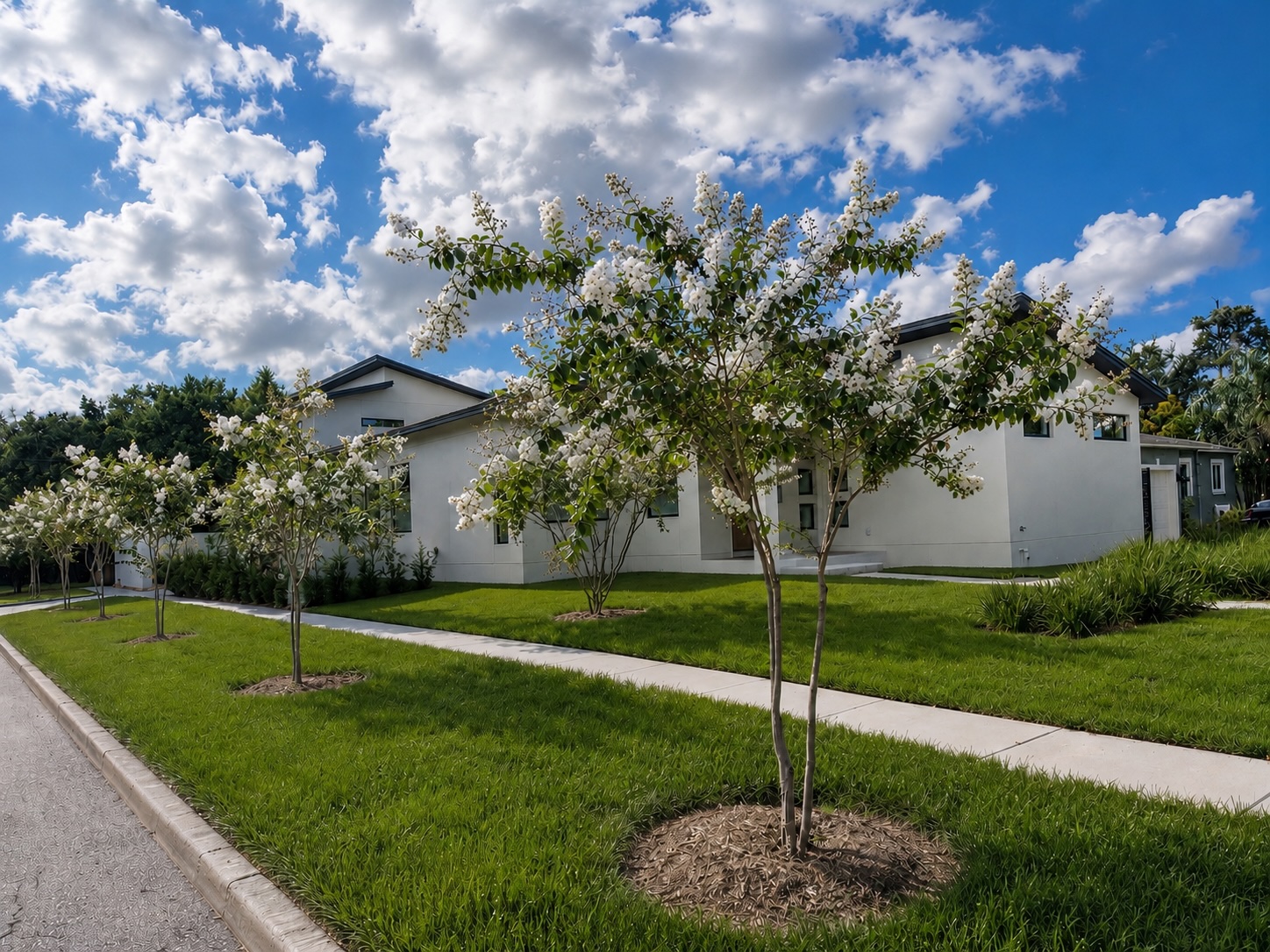
Flowering trees matter in a different register. Crape myrtles, in particular, have become one of St. Petersburg’s seasonal signatures. For years across the South, the habit of aggressively topping them every winter was so common it earned the grim joke “crape murder.” I have noticed less of that lately. More trees seem to be reaching a natural mature form instead of being cut back into blunt stubs year after year. That is only what I have been seeing on the streets I travel most. Still, the difference is visible.
My own favorite is the Natchez crape myrtle. It has an extraordinarily long flowering season and a sculptural mature form that grows more interesting with age. The bark sheds in soft plates to reveal cinnamon-toned wood underneath, so the trunk stays beautiful even when the blossoms rest. The white flowers arrive in long, generous waves. When the petals blow across the pavement, the street can look briefly like snowfall in a Florida summer — improbable and oddly moving.
At my current house, nine Natchez crape myrtles line the street. They are not a backdrop. They are part of how the place greets you.
Natchez is not the only flowering tree that can define a street by season. In the Live Oaks neighborhood, a pink Tabebuia once did that work in a more dramatic key.
Before the modern home in this photograph existed, the property was part of Hazel’s Garden & Nursery, a small residential nursery that once occupied five lots in Live Oaks. I know that history firsthand because I worked with Kasper Modern Homes, the builder that acquired the property and developed the homes that stand there today.
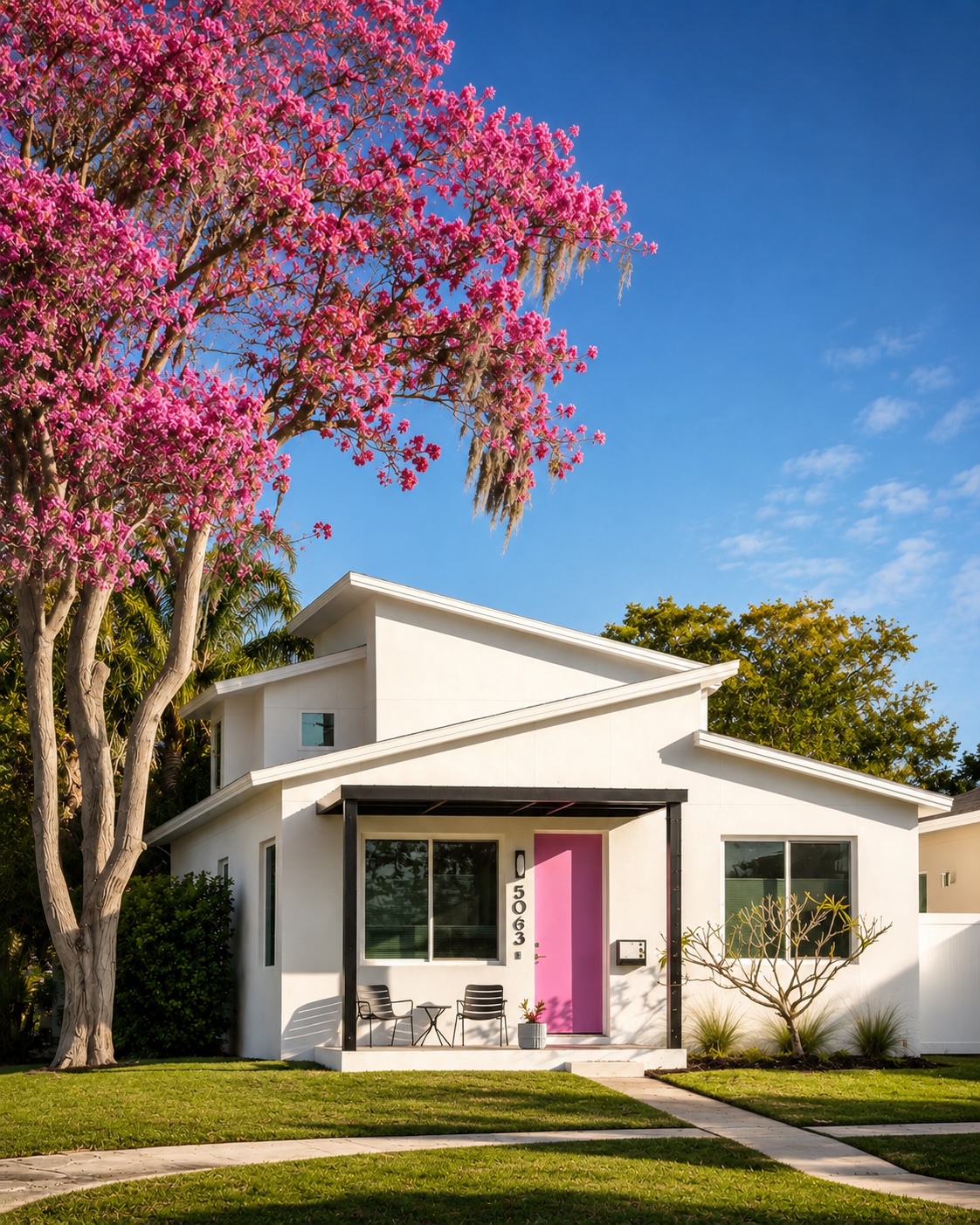
This extraordinary pink Tabebuia was planted by Hazel herself and remained after the nursery was redeveloped. In full bloom, its pink-purple canopy rose above the modern white house beneath it, and the pink front door seemed to answer the color overhead. It became one of those neighborhood landmarks people simply knew.
The tree also lived beside overhead electrical lines, so utility crews periodically cut portions of the canopy away. It was never really able to develop the broad natural form it might have had in a more open setting. Even so, the homeowner cared deeply about preserving its beauty and hired an excellent tree company to shape what remained as gracefully and artistically as possible.
Eventually, concerns about the tree’s size, roots and wind exposure led to the decision to remove it. The reasons were understandable, and the tree had been thoughtfully maintained for years. Still, its absence is felt. Some mature trees become more than landscaping. They become part of the visual memory of a street.
Sometimes the most important features of a neighborhood were never drawn on an architect’s plans. They grew there.
St. Petersburg never has just one landscape
One of the quiet privileges of living here is botanical range. Tropical planting and more traditional Southern planting can share the same city, sometimes the same block. Palms may give way to mature live oaks. Flowering trees appear beside clipped hedges, cottage gardens, warm-climate plants, native mixes or more formal compositions.
That variety is part of what makes walking or driving through the city interesting. You can leave a street of palms and open light and, a few turns later, find yourself under a darker oak canopy with brick beneath the tires. Meanwhile another corridor may lean cottage-garden; at the same time, a neighboring block may present clipped hedges and a cleaner architectural line. None of these approaches is the official St. Petersburg style.
Because of that range, two streets a short distance apart can feel like different climates of mind. A carefully kept tropical garden can be as eloquent as a restrained oak-and-lawn streetscape. What matters is coherence and care — whether the planting seems to belong to the house and the street it faces.


A city of different personalities
St. Petersburg’s neighborhoods are not interchangeable chapters of the same brochure. Old Northeast has its own rhythm of brick, canopy and historic residential fabric. Old Southeast carries a related historic sensibility with a different grain — still old-house and street-conscious, yet with its own pace and proportion.
Historic Kenwood has long been associated with bungalow-era streetscapes, porches and a strong sense of craft. Central Oak Park and Live Oak — neighboring but distinct — remind you that tree-lined character is not reserved for the city’s most photographed addresses. Lake Pasadena has a quieter residential atmosphere. Jungle Prada brings a different coastal and landscape mood. Eagle Crest, Allendale and Snell Isle each hold a different relationship to water, lot pattern, architecture and light.
None of that is a ranking. It is a map of personalities. In fact, one of the things I love about St. Petersburg is that these places can feel completely different from one another while spanning a wide range of housing styles and price points. The city’s sense of place is distributed across bungalows, Mediterranean Revival homes, mid-century houses, newer construction and many hybrids in between.
That is one reason I encourage people to experience neighborhoods in person. Filters are useful, yet blunt. A screen can measure square footage. It is much worse at measuring the feeling of walking under a canopy at dusk.
A house on the hill
I once listed one of the early homes in Historic Roser Park. What has stayed with me is less the listing paperwork than the arrival. The house sat high on a hill, wrapped in mature trees and lush landscaping, with a topography that felt almost improbable for this part of Florida. You climbed into the place rather than merely approaching it. The street itself seemed to participate in the setting.
You do not expect that kind of rise and fall in St. Petersburg. Roser Park offers it anyway, along Booker Creek, with brick streets and a historic residential fabric that still holds. The hills are not dramatic by mountain standards. Yet in a coastal Florida city, even modest topography becomes memorable — changing the light, how houses sit in the landscape, and the way you remember the neighborhood after you leave.
The neighborhood was developed by Charles Martin Roser, an Ohioan who arrived during the city’s early twentieth-century growth and built what became an early streetcar suburb outside downtown. Roser Park is widely described as shaped by City Beautiful ideas — designed landscape, park space and livable streetscapes as part of the city itself. The district is listed on the National Register of Historic Places for its significance in community planning and development, architecture and landscape architecture.
Local history has also long linked Roser’s fortune to the Fig Newton. The story is more complicated than the folklore. According to the Historic Roser Park Neighborhood Association, some accounts credit Charles Roser with helping develop a fig-cookie recipe or baking process later associated with Nabisco, while Nabisco’s own account has pointed instead to James Henry Mitchell and the machinery that made filled cookies practical. The careful way to say it is this: Charles Roser — the developer whose fortune has long been linked in local lore to the Fig Newton — left St. Petersburg a neighborhood whose hills, creek, brick streets and historic houses still feel unlike almost anywhere else in the city.

ROSER PARK
A Different Kind of Quiet
Roser Park feels a little more tucked away than the rest of the city. The streets curve, the greenery grows in layers, and the houses feel discovered rather than announced. It has a softer, more private rhythm — one that makes even a short walk feel slower and more considered.
Part of the charm is how architecture and landscape work together. Porches sit behind planting, mature trees filter the light, and the homes feel rooted in their surroundings instead of simply placed on a lot. It is one of those neighborhoods where character comes from atmosphere as much as architecture.
In Roser Park, the setting is part of the architecture.
What buyers can miss
There is a practical side to all of this, and it shows up quickly when people begin a search. Requirements are often completely legitimate. A certain amount of square footage may be necessary. A garage may matter. A larger yard may matter. A preference for a particular house type can be equally reasonable. None of those preferences is foolish.
However, every requirement carries a tradeoff. Insist on enough criteria at once and whole stretches of St. Petersburg can disappear from view before you ever drive them. Sometimes the missing piece is not a better house. It is a better street — interesting architecture, mature landscaping, a smaller but better-composed home, a neighborhood with a stronger sense of place.
I have watched buyers box themselves out of neighborhoods they would have loved because the search was drawn too tightly around a checklist. Require too much square footage and the charming street never appears. Insist on a garage and certain older blocks drop away. Demand a very large yard and you may never see the compact historic house whose porch and canopy would have made you happier.
Yet this is not an argument against practical needs. It is an argument for understanding tradeoffs clearly enough to leave room for discovery. The spreadsheet can be right and the feeling still wrong.
Sometimes the house that looks imperfect on a spreadsheet is sitting on the street you will love every day.
If you are buying here, see the streets in person. Notice the canopy, the maintenance, and whether the block feels quiet or restless. Those impressions are data, too — just not the kind a filter displays cleanly.
Beauty is cumulative
Private property creates public experience. That sounds abstract until you walk a street where one yard is carefully planted, the next freshly painted, the next shaded by a preserved oak, and the next neglected. The emotional temperature of the block changes house by house.
Making St. Petersburg beautiful, in the way I have come to mean it, is not a slogan. It is keeping a yard tended, a house painted and tidy, a healthy tree preserved when possible, and a beautiful tree planted when the chance appears. It is remembering that each property contributes to the appearance of the whole street.
A beautiful city is built one property at a time. One beautiful yard cannot redeem a neglected corridor by itself. Hundreds of small acts of care can. Houses remain private; collectively, their gardens, porches, fences, façades and trees become the city people move through.
Even paint belongs to that civic layer. A thoughtful exterior palette can quiet a façade the way a canopy softens a skyline. I have written elsewhere about how carrying one warm color through walls, trim and ceiling can change a room; the same attentiveness outdoors changes a block.

The Short Version
Start here:
- The character of a street comes from more than the houses themselves.
- Mature, healthy trees are part of a neighborhood’s architecture.
- Brick streets and older infrastructure still shape St. Petersburg’s sense of place.
- Landscaping does not need one official style to be beautiful; coherence and care matter more.
- Maintaining yards and homes contributes to the daily experience of an entire street.
- Highly restrictive search criteria create real tradeoffs — sometimes at the expense of streets you would love.
- A smaller house on the right block can outweigh a larger house somewhere that never feels right.
- St. Petersburg’s neighborhoods should be experienced in person, not only filtered on a screen.
Frequently Asked Questions
What makes St. Petersburg neighborhoods feel different from one another?
Streetscape does as much work as architecture. Tree canopy, brick paving, landscaping, setbacks, porches, lot patterns and maintenance combine into a first impression — which is why two streets a few blocks apart can feel entirely different.
Which St. Petersburg neighborhoods have brick streets and historic homes?
Several historic areas are known for brick streets and older residential fabric, including parts of Old Northeast, Old Southeast, Historic Kenwood and Historic Roser Park. The best way to understand them is to walk or drive the streets rather than rely on photographs alone.
Why are mature live oak trees important to neighborhood character?
Live oaks set scale, shade and continuity. They cool a street, frame houses and signal that a place has been allowed to age with care. When healthy mature trees are removed without necessity, the loss is usually felt by the whole block.
What is “crape murder”?
It is the informal name for severely topping crape myrtles instead of allowing them to develop a natural mature form. I have personally noticed less of that aggressive cutting on the streets I travel most, though practices still vary.
What should buyers consider besides square footage when choosing a St. Petersburg home?
Pay attention to the street itself: canopy, light, landscaping, architecture, maintenance and how the block feels at different times of day. Practical needs still matter. So does whether you will enjoy coming home to the place around the house.
Does St. Petersburg have many different architectural styles?
Yes. Across the city you will find bungalows, Mediterranean Revival homes, mid-century houses, newer construction and many hybrids in between. Historic Roser Park is especially known for a wide mix of early twentieth-century styles within a compact historic landscape.
What makes Historic Roser Park unusual?
Its topography, Booker Creek setting, brick streets and designed historic landscape give it a character uncommon in much of flat coastal Florida. Developed by Charles Martin Roser as an early streetcar suburb, it is listed on the National Register of Historic Places.
What should I look for when exploring St. Petersburg neighborhoods?
Look beyond listing photos. Notice trees, gardens, porches, paint, paving and how the street holds together. Visit more than once if you can — morning light and late-afternoon light often tell different stories about the same block.
Why I stayed
I grew up in North Carolina. As a child, my family traveled to St. Pete Beach, and even then St. Petersburg had a feeling I could not quite name — something sweeter and more layered than a simple vacation town. Those trips stayed with me as happy memories.
Years later, after living in San Francisco, I decided to move back East. St. Petersburg was not one option among many. It was essentially the city I wanted. What I love now is still close to what I sensed then: the feeling in the air, summer thunderstorms that leave the streets rinsed and green, frequent rainbows, sunshine, and breezes that move through because the city sits between Tampa Bay and the Gulf. The vegetation is lush. The light keeps changing.
I do not need a climate ranking to explain it. I live it. The storms pass. The trees shine. Somewhere a brick street turns gold for a minute before dusk.
There’s a sweetness to living here.
